Vehicle Gate Access Control Systems for Standalone & Autonomous Entry
Fresh USA provides vehicle gate access control systems for commercial, residential and industrial gates, including standalone and autonomous solutions for automatic vehicle entry. These systems can identify authorized vehicles and control compatible gates or barrier arms without depending on a cloud service or a continuously connected computer for normal gate operation.
Solutions are available for short-, medium- and long-range vehicle access. Customers can choose between very simple autonomous systems using protected authorization codes or a more advanced autonomous system with individual vehicle credentials, an embedded local database, access records and Windows management software.
Best fit: recurring vehicles that need fast gate entry using RFID cards, windshield tags or vehicle tags, with local authorization and direct gate or barrier relay control. For broader vehicle-access projects involving multiple identification methods, visitor workflows or centralized site-wide management, see the Vehicle Access Control Systems overview.
Configure Your Vehicle Gate Access Control System
Select the access system that fits your vehicle entrance. Compare simple stand-alone gate access using F-910, F-920 or F-930, the advanced autonomous FA-900 GatePilot, or a software-managed access control system when centralized users, logs, schedules or multiple readers are required.
Choose the required reading distance, number of entry and exit lanes, credentials and management options to see an estimated equipment configuration and request an exact delivered quote.
Configure Vehicle Gate Access System →
Use the dedicated Fresh USA configurator to compare standalone, autonomous and software-managed options by reading distance, lanes, credentials and management requirements.
Quick selection: choose F-910 for shorter controlled entrances, F-920 for medium-range vehicle access, F-930 for simple long-range stand-alone operation, or FA-900 GatePilot when individual vehicle credentials, event history and easier credential management are required.
Vehicle Gate Access Control That Works Locally
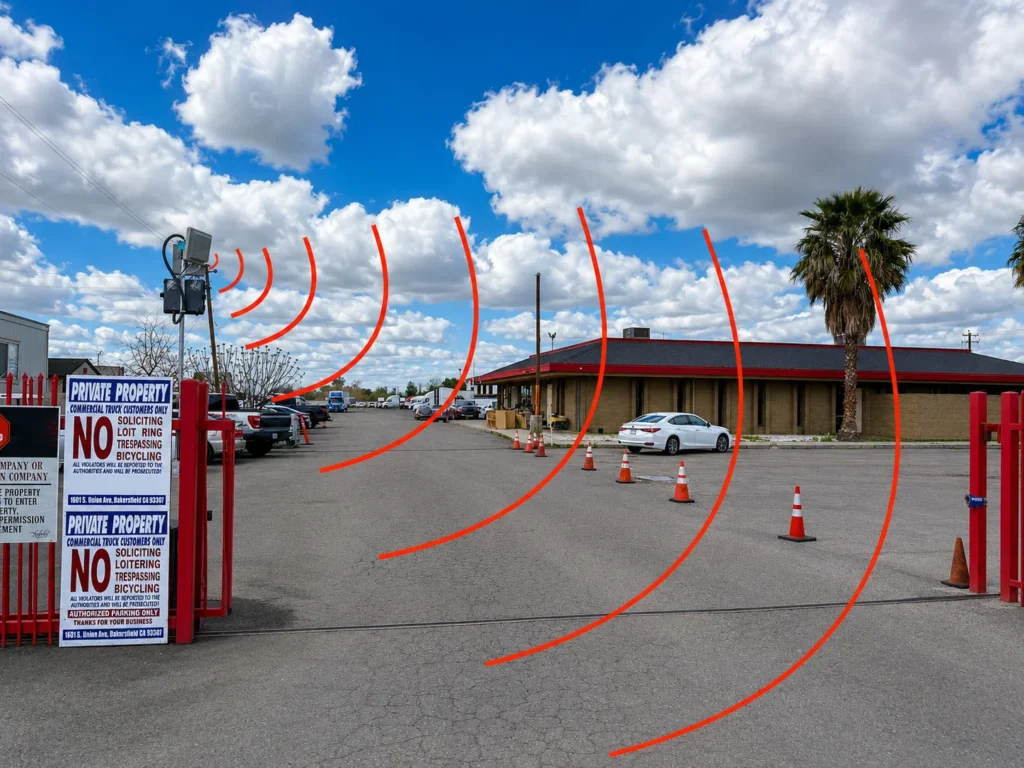
A vehicle gate access control system identifies an approaching vehicle credential, verifies whether access is authorized and then provides an opening command to a compatible gate operator, barrier arm or other controlled vehicle entrance.
For recurring drivers, this process can happen automatically. The driver does not normally need to stop, enter a PIN or wait for manual approval.
Fresh USA offers two different autonomous architectures:
- Simple standalone access: F-910, F-920 and F-930 use a cryptographically protected shared authorization code and provide extremely simple autonomous vehicle access.
- Managed autonomous access: FA-900 GatePilot™ stores individual vehicle credentials in its own embedded authorization database and provides Windows-based management, event history and reports.
Both approaches make the normal access decision locally. The main difference is how credentials are created, administered and revoked.
Simple Standalone Vehicle Gate Access Control: F-910, F-920 & F-930
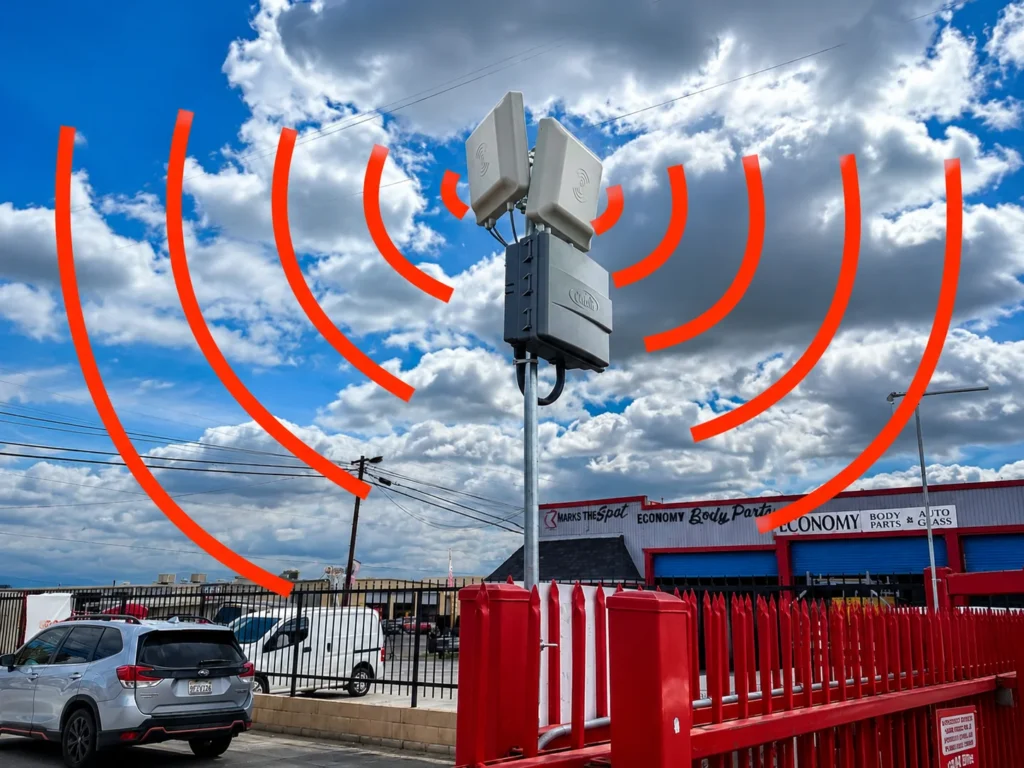
The F-910, F-920 and F-930 are designed for customers who want straightforward autonomous vehicle access without maintaining an individual user database.
Each standalone reader contains a corresponding cryptographically protected system authorization code. Compatible cards, windshield stickers or vehicle tags are programmed with the same protected authorization code.
When a compatible credential enters the reading zone, the reader verifies that the protected code in the credential corresponds to the protected code stored in the reader.
If the credential is accepted, the reader activates its standard built-in NO dry-contact relay, which can provide the opening command to a compatible gate or barrier control input.
Typical standalone access sequence:
Authorized Card / Vehicle Tag → Local Reader Verification → NO Dry-Contact Relay → Gate or Barrier Opens
Virtually Unlimited Matching Credentials
The F-910, F-920 and F-930 standalone architecture does not maintain a fixed database containing every individual user. Instead, authorization is based on the matching protected system code.
Because of this, a large number of compatible cards or tags can be programmed with the same protected authorization code and used with the corresponding reader. There is no practical individual-user database limit in this simple standalone architecture.
Protected Authorization Code — Not an EPC Number
The protected authorization code used by F-910, F-920 and F-930 should not be confused with the ordinary EPC number of an RFID tag.
- The protected access code is not the EPC number.
- The protected access code is cryptographically protected.
- It is not exposed as an ordinary readable EPC value.
- Standard third-party RFID readers cannot simply read this protected authorization code as normal EPC data.
- The Fresh USA reader verifies the protected credential information locally.
This provides a simple autonomous authorization mechanism without requiring an individual credential database in the reader.
Adding New Cards, Windshield Stickers or Vehicle Tags
New compatible credentials can be programmed with the protected authorization code currently used by the standalone reader.
This can be done before the credentials are supplied to users, or compatible writable credentials can be programmed locally using the Fresh USA F-02 USB desktop reader / writer.
Adding a new user is simple:
- Use the protected authorization code already assigned to the standalone system.
- Program the new compatible card, sticker or vehicle tag with that code.
- Give or install the new credential for the authorized user.
- The existing reader does not need a new individual database record for that user.
How Lost or Retired Standalone Credentials Are Disabled
The simple standalone architecture has an important difference from a database-managed system.
Because F-910, F-920 and F-930 do not maintain an individual list of every card or vehicle tag, one particular lost credential is not deleted individually from the reader.
Instead, when an old, lost or unreturned credential must become invalid, the system can be migrated to a new protected authorization code.
Protected Code Rotation
The recommended process is:
- Create a new protected authorization code.
- Program new cards or tags with the new protected code.
- Reprogram the existing credentials of users who should continue to have access.
- After active credentials have been prepared, program the F-910, F-920 or F-930 reader with the same new protected code.
- Credentials that still contain the previous protected code immediately become invalid for that reader.
Valid Users Reprogrammed → Reader Changed to New Code → Old Credentials Become Invalid
This provides a practical way to invalidate lost, unreturned or former-user credentials without replacing the complete standalone system.
Existing Vehicle Tags Can Be Reprogrammed
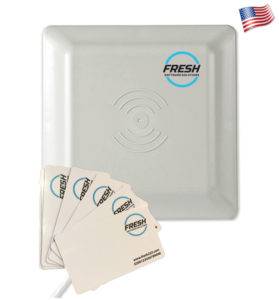
Vehicle credential for standalone gate access
A compatible writable windshield sticker or permanently installed vehicle tag does not necessarily have to be removed from the vehicle when the protected system code changes.
A technician can approach the vehicle with a laptop and the F-02 USB desktop reader / writer and reprogram the accessible writable credential with the new protected authorization code.
This can be particularly convenient for windshield stickers or vehicle tags that are already installed and should remain physically attached to the vehicle.
The physical tag can remain in place while its authorization information is updated.
After the reader itself is changed to the new protected code, credentials that were not reprogrammed remain on the old code and can no longer authorize the gate.
Vehicle Gate Access Control Reader Options
F-910 Vehicle Gate Access Control — Up to 13 ft / 4 m
The F-910 is designed for shorter and more controlled vehicle reading zones where long-distance detection is unnecessary.
- Reading range: up to 13 ft / 4 m
- Polarization: circular
- Authorization: cryptographically protected shared system code
- Gate control: built-in NO dry-contact relay
- Normal operation: no continuously connected PC required
- Credentials: virtually unlimited compatible credentials using the matching protected system code
F-920 Vehicle Gate Access Control — Up to 26 ft / 8 m
The F-920 provides a medium reading distance for vehicle entrances where the authorized vehicle should be identified before reaching the immediate gate area.
- Reading range: up to 26 ft / 8 m
- Polarization: circular
- Authorization: cryptographically protected shared system code
- Gate control: built-in NO dry-contact relay
- Normal operation: no continuously connected PC required
- Credentials: virtually unlimited compatible credentials using the matching protected system code
F-930 Vehicle Gate Access Control — Up to 50 ft / 15 m
The F-930 provides long-range standalone vehicle access for entrances where approved vehicles should be identified farther from the gate or barrier.
- Reading range: up to 50 ft / 15 m
- Polarization: circular
- Authorization: cryptographically protected shared system code
- Gate control: built-in NO dry-contact relay
- Normal operation: no continuously connected PC required
- Credentials: virtually unlimited compatible credentials using the matching protected system code
FA-900 GatePilot™ Managed Autonomous Vehicle Access
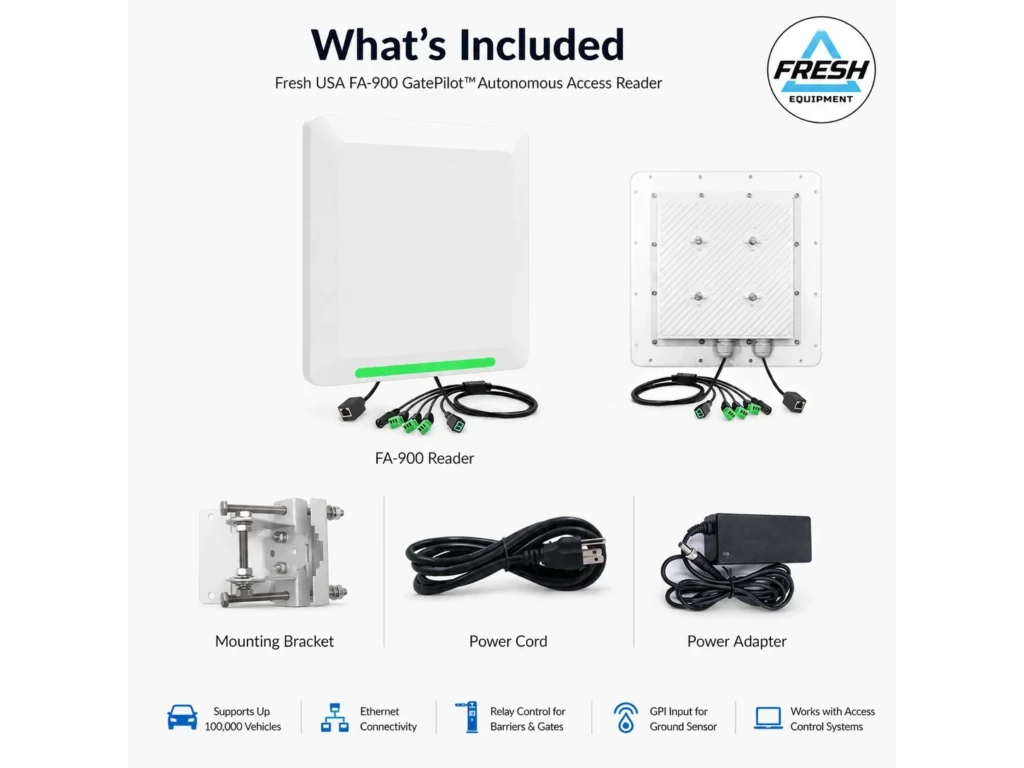
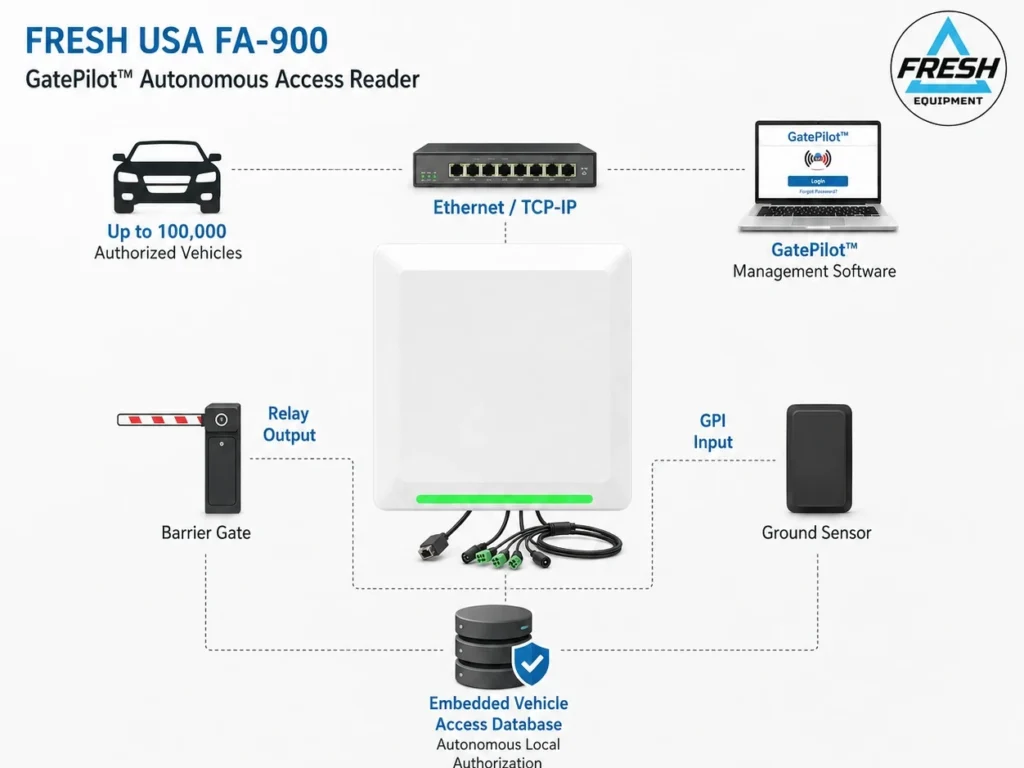
The FA-900 GatePilot™ is designed for projects that still require autonomous local gate operation but also need individual credential management.
Unlike the protected shared-code architecture of F-910, F-920 and F-930, FA-900 maintains an embedded local authorization database.
Compatible RFID credential IDs / EPCs can be read individually and added to the FA-900 database. Each authorized vehicle credential therefore exists as its own record.
- Reading range: up to 50 ft / 15 m
- Polarization: circular
- Embedded authorization database: up to 100,000 authorized 96-bit credentials
- Individual credential management: add, block or remove individual credentials
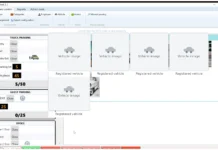
- Management: Windows GatePilot™ Management Software included
- Network: TCP/IP Ethernet management
- Gate control: 2 relay outputs
- Additional interfaces: GPI, Wiegand and RS485
- Records: access activity, entry / exit records and downloadable reports
- Subscription: no monthly fee required
GatePilot™ Management Software Included — No Monthly Fees, No Subscription Required
View FA-900 GatePilot™ / Price
How FA-900 Credential Management Works
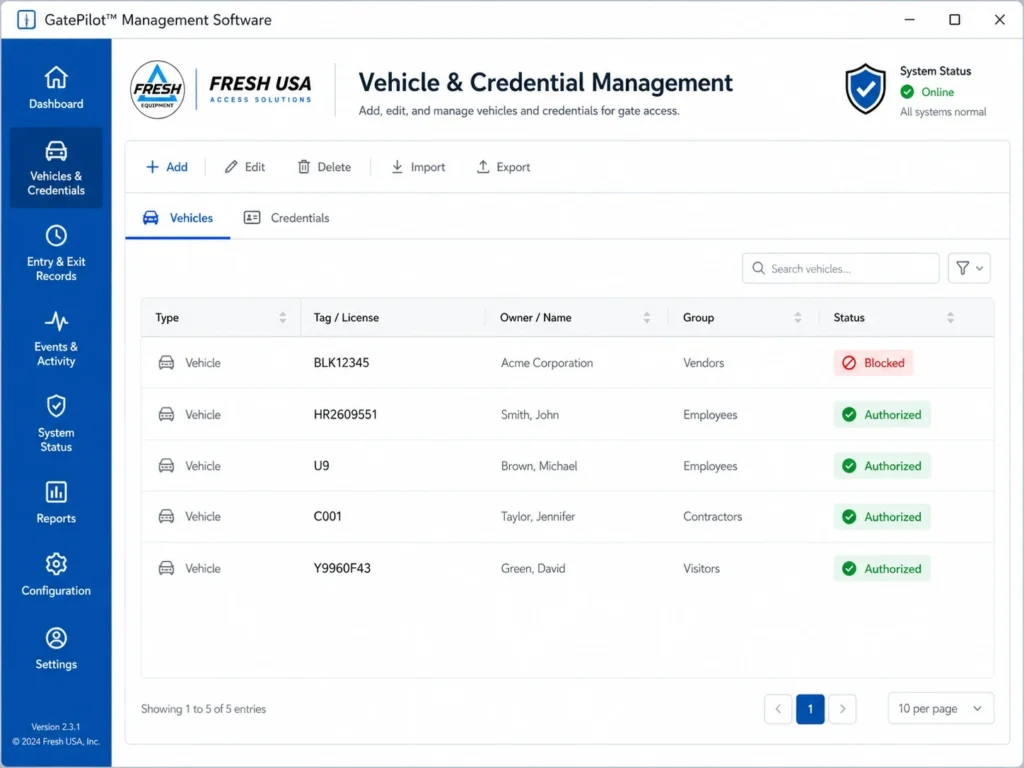
A compatible credential can be presented to the FA-900. The reader can identify the credential ID / EPC and that individual credential can then be added to the local authorization database.
Typical FA-900 enrollment process:
Read Individual Credential ID / EPC → Add Credential to Embedded Database → Authorize Vehicle
Because FA-900 works with individual authorization records, the F-02 is not normally required simply to authorize an existing compatible credential in the FA-900 database.
The F-02 remains useful when data actually needs to be written or changed on a writable RFID credential itself.
Individual Lost Credentials Can Be Disabled
If a vehicle tag or credential is lost, the administrator can block or remove that individual credential record from FA-900 without changing the credentials of all other authorized users.
Lost Credential → Block / Remove Record → Other Authorized Credentials Continue Working
The PC Manages the System — FA-900 Operates the Gate
GatePilot™ Management Software is used to configure the system, manage credentials and review access activity.
However, the Windows computer does not have to remain continuously connected for every normal gate-opening decision.
Once the FA-900 has its local database and operating parameters, the reader can continue making normal authorization decisions locally.
Configure. Disconnect. Keep Running.
F-910 / F-920 / F-930 vs. FA-900 GatePilot™
| Feature | F-910 | F-920 | F-930 | FA-900 GatePilot™ |
|---|---|---|---|---|
| Architecture | Simple standalone | Simple standalone | Simple standalone | Managed autonomous |
| Reading Range | Up to 13 ft / 4 m | Up to 26 ft / 8 m | Up to 50 ft / 15 m | Up to 50 ft / 15 m |
| Polarization | Circular | Circular | Circular | Circular |
| Authorization Method | Protected shared system code | Protected shared system code | Protected shared system code | Individual credential ID / EPC database |
| Authorization Based on EPC? | No | No | No | Individual ID / EPC is used for database authorization |
| Credential Capacity | Virtually unlimited matching credentials | Virtually unlimited matching credentials | Virtually unlimited matching credentials | Up to 100,000 individual credentials |
| Add New Credential | Program credential with protected system code | Program credential with protected system code | Program credential with protected system code | Read ID / EPC and add individual record |
| Disable One Lost Credential | Change system code and migrate valid credentials | Change system code and migrate valid credentials | Change system code and migrate valid credentials | Block or remove the individual credential |
| F-02 Used for Credential Programming | Yes, for local programming / reprogramming | Yes, for local programming / reprogramming | Yes, for local programming / reprogramming | Not normally required for database enrollment |
| Continuously Connected PC Required | No | No | No | No for normal local authorization |
| Internet Required for Normal Authorization | No | No | No | No |
| Gate Control Output | Built-in NO dry-contact relay | Built-in NO dry-contact relay | Built-in NO dry-contact relay | 2 relay outputs |
| Management Software Included | No | No | No | Yes — GatePilot™ |
| Individual Event History / Reports | No in basic standalone mode | No in basic standalone mode | No in basic standalone mode | Yes |
| Best Fit | Short-range simple autonomous access | Medium-range simple autonomous access | Long-range simple autonomous access | Long-range autonomous access with individual credential management |
Advantages and Tradeoffs
F-910 / F-920 / F-930 — Simple Protected-Code Standalone Access
Advantages:
- Very simple autonomous architecture
- No continuously connected PC required
- No cloud dependency for normal authorization
- Cryptographically protected authorization code
- Protected code is not the normal EPC number
- Virtually unlimited compatible credentials using the same protected system code
- New credentials can be programmed locally using F-02
- Compatible writable vehicle tags can be reprogrammed while remaining installed
- Standard built-in NO dry-contact relay
- Three available reading-distance options
Tradeoffs:
- No individual user database in basic standalone operation
- One lost credential cannot be deleted individually from the reader
- Invalidating previous credentials requires changing the protected system code
- Active credentials must be migrated to the new code when a code change is performed
- No individual standalone event history or reports
FA-900 GatePilot™ — Managed Autonomous Access
Advantages:
- Autonomous local authorization
- Individual credential management
- Up to 100,000 local authorized credential records
- One lost credential can be blocked or removed individually
- No need to reprogram every active credential when one user is removed
- GatePilot™ Windows management software included
- Whitelist / blocklist management
- Real-time access events
- Entry / exit records
- Downloadable reports
- Two relay outputs
- No monthly subscription required
Tradeoffs:
- More initial configuration than a simple protected-code reader
- A Windows computer and network connection are used when managing the database, changing settings or reviewing records
- For complex enterprise installations with advanced centralized schedules and shared multi-reader permissions, a full centralized access-control architecture may be more appropriate
F-930 vs. FA-900 GatePilot™ — Same Long Range, Different Management
F-930 and FA-900 can both provide reading distances up to 50 ft / 15 m. Therefore, the main difference between them is not maximum range.
The important difference is how authorized credentials are managed.
Choose F-930 When:
- You want a very simple long-range autonomous gate access system.
- Your authorized user group is relatively stable.
- You want virtually unlimited credentials using one protected system authorization code.
- You do not need individual vehicle records in the reader.
- Changing the common protected code is acceptable when old credentials must be invalidated.
- Detailed individual standalone access records are not required.
Choose FA-900 GatePilot™ When:
- You want long-range autonomous access with individual credential management.
- Vehicles or users are added and removed frequently.
- You want to disable one lost credential without changing everyone else’s access.
- You need allowlist / blocklist management.
- You want access activity and downloadable reports.
- You want the PC to manage the system without depending on the PC for every gate-opening decision.
Vehicle Gate Access Control with Dry-Contact Gate and Barrier Integration
F-910, F-920 and F-930 include a standard NO dry-contact relay.
When an authorized credential is successfully verified, the reader can activate this relay and provide the opening command to a compatible gate operator or barrier controller input.
FA-900 GatePilot™ provides two relay outputs for autonomous gate-control integration.
Authorized Credential → Local Authorization → Dry-Contact Relay → Gate Operator → Gate Opens
Typical controlled entrances include:
- Swing gates
- Sliding gates
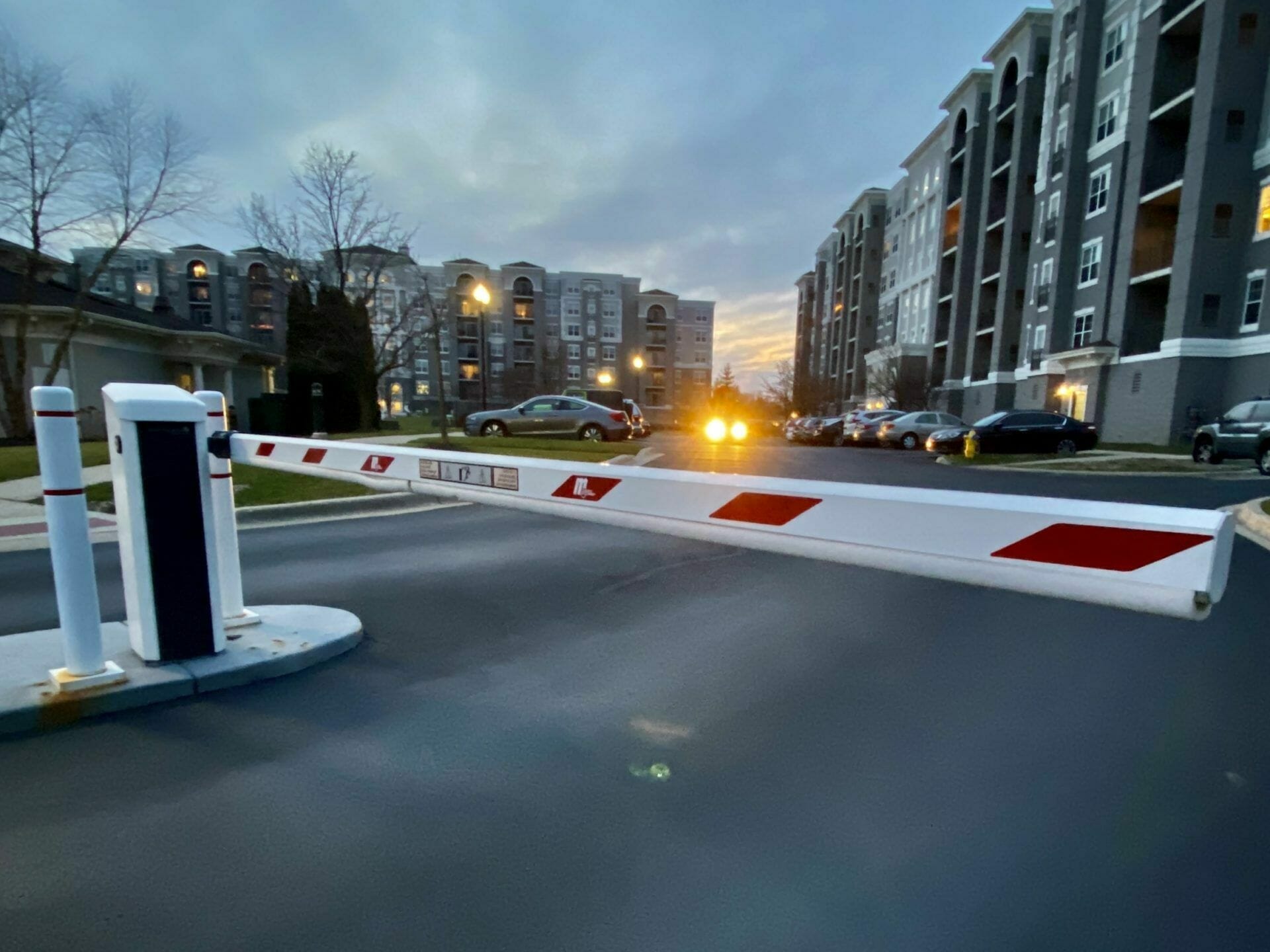
- Barrier arms / boom gates
- Garage entrances
- Commercial driveway gates
- Warehouse entrances
- Industrial yards
- Fleet entrances
- Private-road gates
Important: access-control authorization and gate safety are different functions. The access reader provides the authorization and opening command. It does not replace required safety devices such as vehicle loops, photo eyes, obstruction detection, reversing devices, emergency controls or other safety components required by the gate operator and installation.
Circularly Polarized Readers for Vehicle Gate Access Control
F-910, F-920, F-930 and FA-900 all use circular polarization.
This is useful for vehicle access because the exact orientation of a windshield sticker, card or mounted credential may vary between different vehicles.
Actual reading distance still depends on several real-world factors, including:
- Credential type
- Credential installation position
- Reader angle and mounting height
- Vehicle construction
- RF power setting
- Metal structures near the lane
- RF reflections
- Adjacent traffic lanes
- Local RF conditions
Maximum reading range is not always the correct setting. The reading zone should be adjusted to the real entrance so that the intended vehicle is detected without unnecessarily detecting credentials in adjacent lanes, nearby roads, parked vehicles or waiting areas.
FA-900 GPI and Vehicle Presence Detection
Some vehicle entrances benefit from combining RFID credential authorization with a separate vehicle-presence signal.
FA-900 provides GPI inputs that can be used with compatible external detection hardware when the installation requires a vehicle trigger or presence signal.
Vehicle Arrives → Vehicle Detector / Ground Sensor → GPI Input → FA-900 Credential Check → Gate Authorization
Where Vehicle Gate Access Control Systems Are Used
Vehicle Gate Access Control for Residential & HOA Gates
Gated residential communities, apartment complexes, condominium entrances, private developments and controlled residential vehicle gates.
Commercial Vehicle Gate Access
Employee entrances, office facilities, commercial properties, business vehicle gates and restricted service entrances.
Industrial & Warehouse Vehicle Gate Access
Factories, warehouses, logistics facilities, distribution centers, loading areas and controlled industrial entrances.
Vehicle Gate Access Control for Fleet, Truck and Storage Facilities
Truck yards, commercial fleets, vehicle storage facilities, RV storage, service yards and recurring fleet vehicle entrances.
Private Roads and Restricted Entrances
Private roads, secured facilities and other entrances where recurring authorized vehicles need automatic access.
How to Choose the Right Vehicle Gate Access Control System
| Project Requirement | Recommended Direction |
|---|---|
| Short controlled reading zone | Consider F-910 — up to 13 ft / 4 m |
| Medium vehicle approach distance | Consider F-920 — up to 26 ft / 8 m |
| Long-range simple standalone access | Consider F-930 — up to 50 ft / 15 m |
| Long range with individual credential management | Consider FA-900 GatePilot™ — up to 50 ft / 15 m |
| Very large number of users but infrequent credential changes | Simple protected-code standalone architecture may be the most efficient solution |
| Frequent additions, removals or lost credentials | FA-900 is generally easier to administer because individual credentials can be managed independently |
| Complex schedules and centralized multi-reader permissions | Consider a centralized software-managed access-control system |
Information to Review Before Installation
- Gate or barrier manufacturer and model
- Number of entry and exit lanes
- Lane width
- Vehicle approach direction
- Required reader-to-credential distance
- Approximate number of authorized vehicles
- How frequently users or credentials change
- Credential type
- Credential installation location on the vehicle
- Reader mounting height and angle
- Nearby public roads or adjacent lanes
- Nearby parked vehicles
- Metal structures and possible RF reflection
- Available power
- Available Ethernet where required
- Whether entry and exit require separate readers
- Whether vehicle-presence detection is required
Need a Different Vehicle Access Architecture?
This page focuses specifically on vehicle gate access control, standalone access and autonomous access systems.
For broader vehicle-access projects involving several identification methods, visitor workflows or other vehicle-security functions, see:
Vehicle Access Control Systems
For parking lot and parking garage access-control applications, see:
Parking Access Control Systems
For a more technology-focused explanation of RFID gate access, readers and credentials, see:
RFID Gate Access Control Systems
For centralized software-managed access control with more advanced permissions and schedules, see:
Fresh USA Access Control Software
Frequently Asked Questions
What is a vehicle gate access control system?
A vehicle gate access control system identifies an approaching authorized credential and provides an opening signal to a compatible gate, barrier or other controlled vehicle entrance.
Can a vehicle gate access system work without a continuously connected computer?
Yes. F-910, F-920 and F-930 make their normal standalone authorization decision locally. FA-900 GatePilot™ also performs normal authorization locally after the embedded credential database and reader settings have been configured.
How do F-910, F-920 and F-930 authorize vehicles?
They use a cryptographically protected shared system authorization code. The reader contains the corresponding protected system code, and compatible authorized cards or vehicle tags are programmed with the matching protected code.
Is the protected authorization code the RFID EPC number?
No. The protected authorization code used by F-910, F-920 and F-930 is not the ordinary EPC number and is not exposed as a normal readable authorization value to standard third-party RFID readers.
How many cards or vehicle tags can be used with F-910, F-920 or F-930?
The simple standalone architecture is not based on maintaining a fixed list of individual users. A large number of compatible credentials can be programmed with the same protected authorization code, allowing virtually unlimited matching credentials.
How are additional standalone credentials added?
A compatible card or writable vehicle tag is programmed with the protected authorization code already used by the reader. The Fresh USA F-02 USB desktop reader / writer can be used for local credential programming.
What happens if a standalone card or vehicle tag is lost?
Because the reader does not maintain an individual user database, the lost credential is not deleted individually. Active users can instead be migrated to a new protected system code, after which the reader is changed to the same new code. Credentials remaining on the old code become invalid.
Does an installed windshield tag have to be removed when the system code changes?
Not necessarily. A compatible writable windshield sticker or fixed vehicle tag can be reprogrammed while it remains installed on the vehicle by approaching the vehicle with a laptop and the F-02 USB desktop reader / writer.
How is FA-900 GatePilot™ different from F-910, F-920 and F-930?
FA-900 uses an individual credential database rather than the shared protected-code architecture. Compatible credential IDs / EPCs are enrolled individually, allowing a single credential to be added, blocked or removed without changing everyone else’s credentials.
What is the difference between F-930 and FA-900?
Both can provide reading distances up to 50 ft / 15 m. F-930 provides simple protected-code standalone operation with virtually unlimited matching credentials. FA-900 adds an embedded database for up to 100,000 individual credentials, Windows management software, event history and reports.
Do F-910, F-920 and F-930 have a gate-control relay?
Yes. F-910, F-920 and F-930 include a standard built-in NO dry-contact relay for compatible gate or barrier opening inputs. FA-900 provides two relay outputs.
Do all four systems use circular polarization?
Yes. F-910, F-920, F-930 and FA-900 use circular polarization.
Does a 50 ft / 15 m reader always need to operate at maximum range?
No. The reading zone should be adjusted to the actual entrance geometry. Excessive reading distance can cause credentials in adjacent lanes, nearby roads, waiting areas or parked vehicles to be detected unnecessarily.
Are monthly subscription fees required?
The simple F-910 / F-920 / F-930 standalone systems do not require a software subscription for normal standalone operation. GatePilot™ Management Software is included with FA-900 and does not require a monthly subscription.
Vehicle Access Control User Manual
Software Installation and User Guide
Request a Vehicle Gate Access Control Recommendation
If you are planning a commercial, residential or industrial vehicle gate access control system and are not sure whether you need simple standalone access, FA-900 managed autonomous access or a centralized software-managed system, Fresh USA can help determine the appropriate architecture.
For the most accurate recommendation, please provide:
- Gate or barrier manufacturer and model
- Number of entry and exit lanes
- Approximate desired reading distance
- Approximate number of authorized vehicles
- How frequently users or credentials are added or removed
- Photos of the entrance or a simple layout drawing
- Whether vehicle-presence detection is required
- Installation location and shipping address