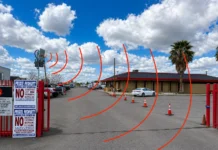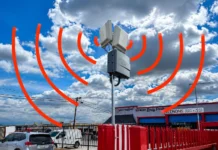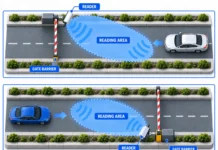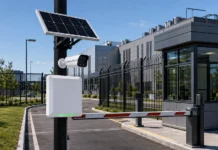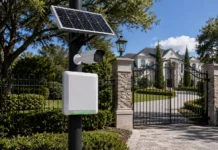
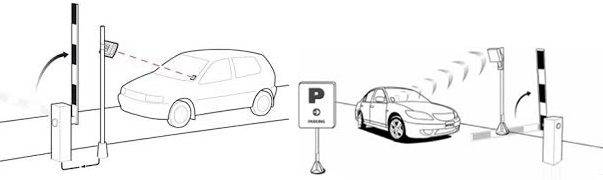
Parking control systems from Fresh USA combine vehicle identification, entry and exit control, barrier or gate automation, access permissions, event history, parking software, and optional payment functions into one integrated parking solution. They are designed for parking lots, parking garages, office properties, apartment and condominium communities, campuses, fleet yards, warehouses, hotels, mixed-use facilities, and other locations where vehicle movement must be controlled rather than simply observed.
Configure Your Parking Control System Request a Quote
A parking control system can be as simple as an autonomous reader that opens a barrier for an authorized vehicle, or as advanced as a multi-lane software-managed system with individual vehicle records, entry/exit tracking, multiple zones, reports, LPR integration, visitor workflows, and paid-parking functions.
View Pricing / Buy Systems Parking Software
How the System Controls a Parking Facility
Parking control systems combine hardware, vehicle identification, gate logic, and software to control how vehicles enter, move through, and exit a parking facility.
The system can decide:
- which vehicles are allowed to enter;
- which gate or barrier should open;
- which parking zone a vehicle may use;
- whether a vehicle is entering or exiting;
- whether the event should be recorded;
- whether a visitor requires approval;
- whether payment is required before exit;
- whether the vehicle should be denied access;
- which operator or workstation can manage the parking system.
This makes parking control broader than a simple gate opener, but more operationally focused than a generic parking-management concept.
Parking Control Systems: Fresh USA Architectures
1. Standalone F‑910 / F‑920 / F‑930
For parking areas that need fast automatic entry without centralized software, parking control systems can use Fresh USA F‑910, F‑920, and F‑930 readers can make the access decision locally and trigger a compatible barrier or gate through a built-in normally-open dry-contact relay.
- F‑910: up to approximately 13 ft / 4 m
- F‑920: up to approximately 26 ft / 8 m
- F‑930: up to approximately 50 ft / 15 m
- Normal operation: no continuously connected PC required
- Internet dependency: none for normal standalone access
- Control output: built-in normally-open dry-contact relay for compatible operators
This architecture is suitable for smaller parking lots, private entrances, employee parking, residential parking, and other sites where the main requirement is fast recurring authorized vehicle access.
2. FA‑900 GatePilot Autonomous Control
FA‑900 GatePilot adds individual vehicle credential management, an embedded local authorization database, offline event records, and Windows-based administration while preserving autonomous local operation.
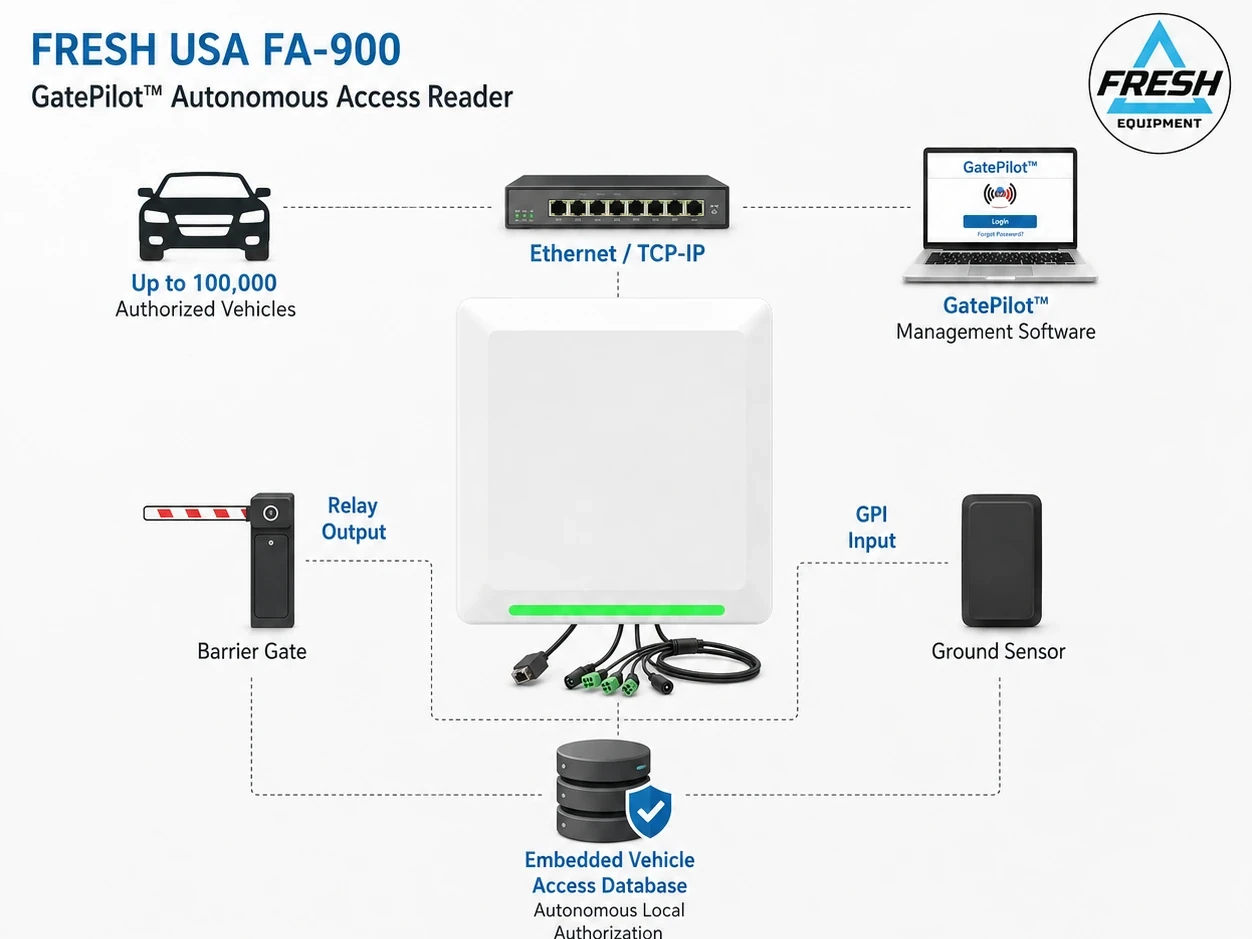
GatePilot is a strong fit where a parking facility needs more control than a simple shared authorization model but does not want normal gate operation to depend on a permanently connected PC or cloud server.
- individual vehicle credentials;
- local authorization database;
- offline event records;
- entry and exit applications;
- credential enrollment and management;
- Windows-based administration;
- remote or solar-capable installation options where suitable;
- support for compatible UHF tollway windshield stickers, including supported I‑PASS / E‑ZPass-type credentials.
3. Centralized Software Management
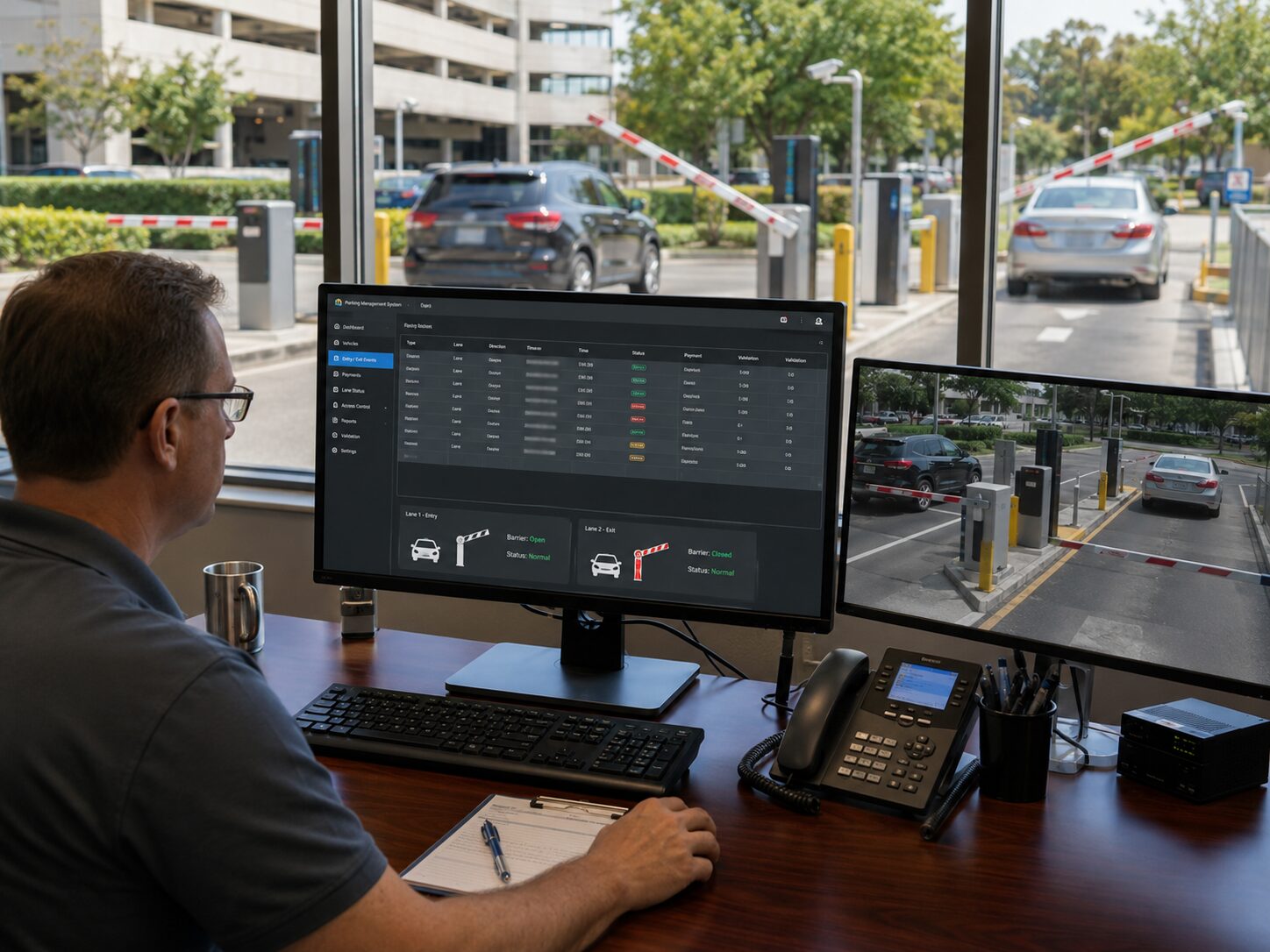
For larger parking lots, garages, campuses, commercial properties, fleet facilities, and multi-lane installations, software-managed parking control systems provide centralized administration across multiple readers and control points.
Depending on the configuration, the system can support:
- vehicle and user databases;
- multiple entry and exit readers;
- current vehicle status in supported entry/exit configurations;
- parking zones and access permissions;
- time schedules and temporary restrictions;
- blacklist / whitelist logic;
- entry and exit event history;
- reports and Excel export;
- multiple Windows operator workstations;
- local SQL or shared SQL database architecture;
- optional cloud-hosted database/server deployment;
- compatible readable UHF tollway windshield credentials;
- project-specific integration with compatible external systems.
View Parking Management Software
How Vehicle Entry and Exit Are Processed
Parking control systems coordinate identification, authorization, gate action, event recording, and exit processing as one operational workflow.
- Vehicle identification: a vehicle approaches the entrance using a supported credential, tag, card, plate-recognition workflow, visitor method, or other configured identification method.
- Authorization: the reader, controller, GatePilot, or software checks whether the vehicle is permitted to use the selected parking entrance or zone.
- Control decision: the system approves or denies the event according to the configured rules.
- Gate action: if access is approved, the compatible barrier, gate, or garage operator receives the opening command.
- Event recording: managed configurations record the event for later review.
- Exit control: the system can process exit independently using a separate reader, lane, LPR workflow, payment validation, or other configured control method.
Entry and Exit Lane Logic
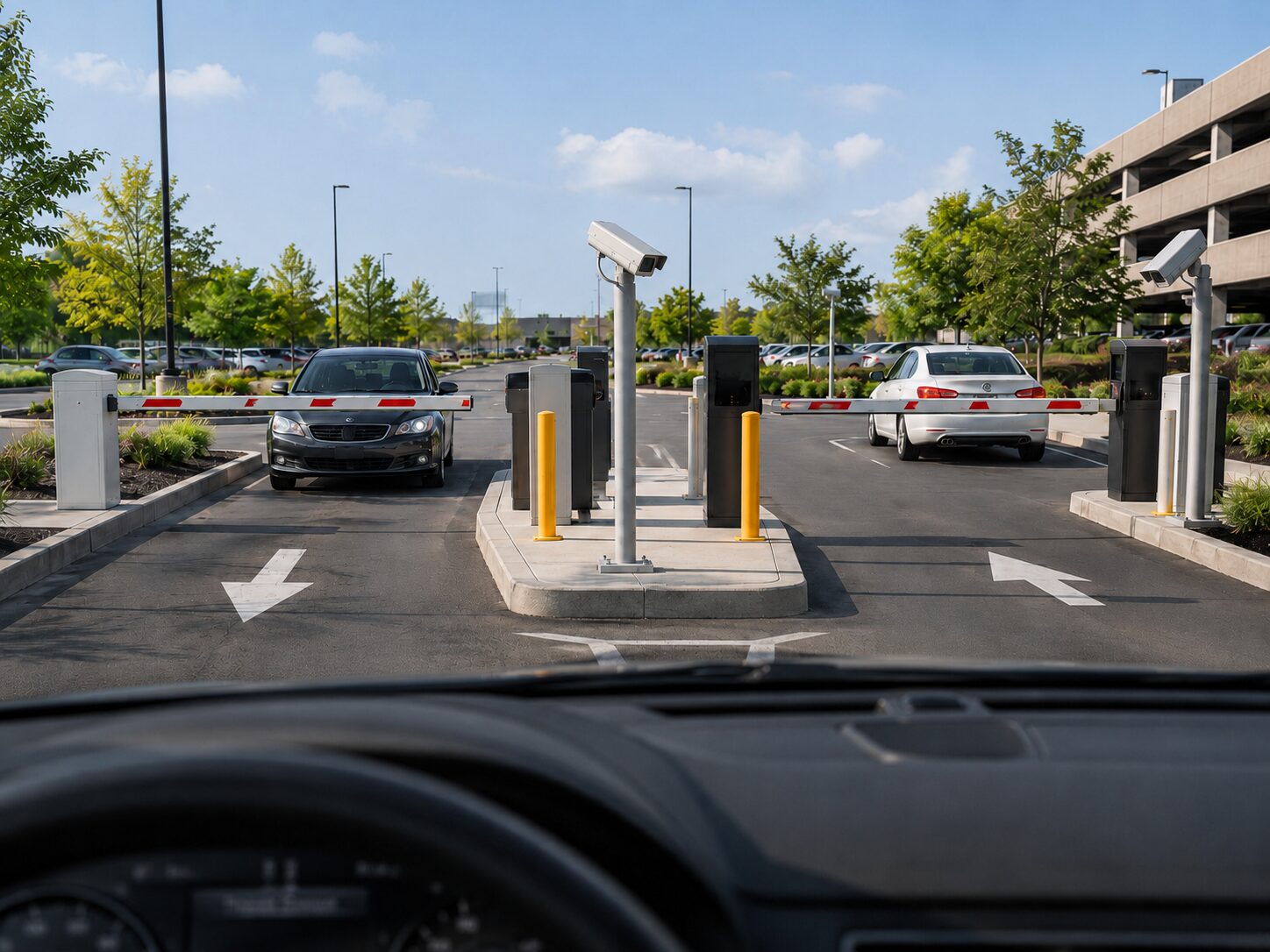
Well-designed parking control systems treat entry and exit lanes as separate control points so direction and vehicle status remain clear.
Reliable parking control depends on treating the entrance and exit as separate operational points. A facility may need one reader for entry and another for exit so the system can distinguish vehicle direction and maintain clear event history.
This is particularly important where operators want to know whether a vehicle is currently inside, which lane was used, or whether an exit should be permitted only after payment or validation.
For the more specific entry/exit application, see Parking Lot Entry and Exit Control Systems.
Vehicle Identification Options
Fresh USA parking control systems can use different identification methods for recurring users, visitors, contractors, and paid-parking customers.
A modern parking control system should not depend on one single identification method. Fresh USA can design the control workflow around the property and the users who actually enter it.
Depending on the project, identification can include:
- long-range UHF vehicle credentials;
- windshield stickers and vehicle tags;
- supported I‑PASS / E‑ZPass-type tollway credentials;
- cards and key fobs;
- license plate recognition;
- keypad or intercom access;
- temporary visitor access;
- mobile or remote gate-opening workflows where supported.
RFID UHF is one useful technology for recurring vehicles, but the primary goal of the parking control system is broader: to control the complete parking workflow at the entrance, exit, and management level.
Paid Parking and Revenue Control
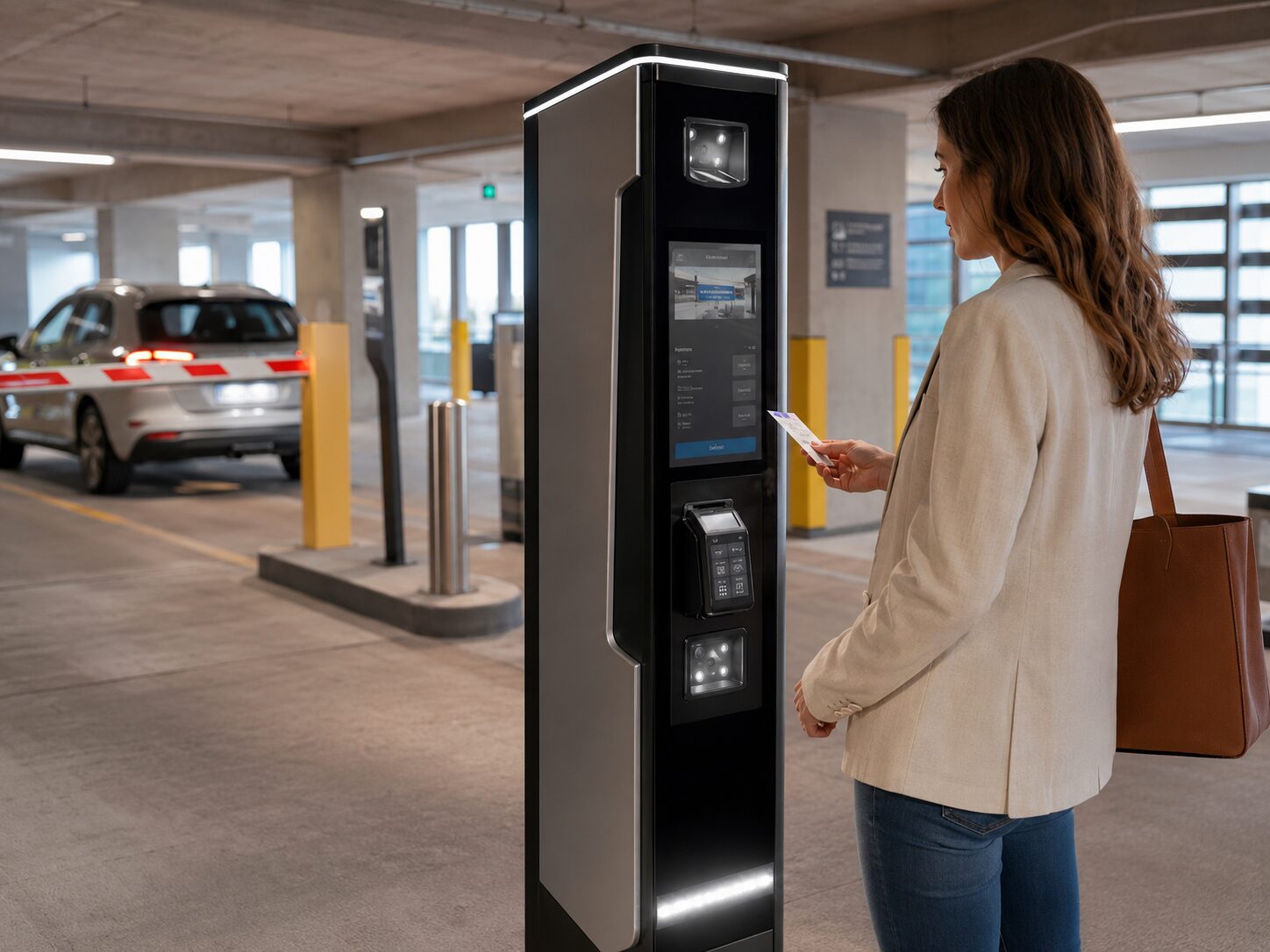
Some parking facilities require both access control and revenue control. In those projects, parking control systems can be expanded with ticketing, LPR, payment validation, parking payment equipment, and exit authorization.
Paid-parking control can include:
- vehicle or ticket identification at entry;
- parking-session tracking;
- fee calculation;
- cash and supported electronic payment workflows;
- payment validation;
- LPR integration;
- barrier control at exit;
- central monitoring and reports.
For the dedicated revenue-control solution, see Parking Payment Systems and Parking Payment Machine & Pay Station.
Parking Control Systems for Existing Gates and Barriers
A parking-control upgrade does not always require replacing the existing barrier, garage door, or gate operator. Fresh USA can review the existing equipment and determine whether the current operator provides a compatible external control input.
Where compatibility is confirmed, the identification and control layer can often be upgraded while retaining the existing physical gate hardware.
This can be useful for:
- existing commercial parking lots;
- office building parking;
- apartment and condominium garages;
- hotel parking entrances;
- warehouse and industrial yards;
- campus parking;
- fleet yards and service facilities.
Access Control vs. Complete Parking Control
Parking access control is primarily about authorization: which vehicle or user is allowed to enter or exit.
Parking control systems are broader operational systems. They can include access authorization, entry and exit control, gates and barriers, event history, software, multiple lanes, vehicle status, visitor handling, and payment control.
For a page focused specifically on authorization technologies and gate access, see Parking Access Control Systems.
Parking Control vs. Parking Management
A parking management system is the broader management layer for parking operations, users, software, reporting, zones, payment workflows, and operational visibility.
A parking control system emphasizes the real-time control of vehicles and equipment at the parking facility: identification, authorization, entry, exit, barriers, access rules, and optional payment validation.
The two functions often work together in the same Fresh USA project.
For the broader platform overview, see Parking Management System.
Typical Applications
Parking control systems can be adapted to private, commercial, residential, institutional, industrial, and paid-parking environments.
- commercial parking lots;
- parking garages;
- office and employee parking;
- apartment and condominium parking;
- HOA and gated-community parking;
- university and hospital campuses;
- industrial and warehouse parking;
- fleet yards and service depots;
- hotel and hospitality parking;
- private and restricted vehicle areas;
- paid public parking.
Why Fresh USA Parking Control Systems
- Multiple architectures: standalone, autonomous GatePilot, or software-managed control.
- Real gate integration: dry-contact and compatible operator control for actual parking entrances.
- Long-range vehicle identification: useful for recurring drivers and high-frequency access.
- Local operation: standalone and GatePilot configurations can operate without cloud dependence for the normal access decision.
- Flexible software: local, shared SQL, or hosted database architectures depending on the project.
- No mandatory monthly Fresh USA software fee: lifetime software license options are available.
- Expandable: begin with one entrance and add readers, exits, zones, workstations, LPR, or payment functions later.
- Tollway credential support: compatible I‑PASS / E‑ZPass-type UHF windshield credentials can be used in supported GatePilot and software-managed configurations.
Information Needed for a Quote
Accurate parking control systems are designed around the actual number of lanes, gate hardware, vehicle volume, identification method, software requirements, and payment workflow.
- number of entrances and exits;
- parking lot or garage layout;
- existing gates, barriers, or garage operators;
- approximate number of recurring vehicles;
- visitor and contractor requirements;
- required reading distance;
- preferred vehicle identification method;
- need for event history and reports;
- need for multiple zones or schedules;
- need for LPR or paid parking;
- available network and power;
- photos or a simple site plan.
Configure Your Parking Control System Request an Exact Quote
Frequently Asked Questions
What is a parking control system?
A parking control system is a combination of vehicle identification, access logic, gate or barrier control, and optional software used to manage vehicle entry, exit, permissions, event history, and related parking operations.
Can a parking control system work without a computer?
Yes. Fresh USA offers standalone F‑910 / F‑920 / F‑930 systems and FA‑900 GatePilot autonomous configurations that can make the normal access decision locally without a permanently connected PC.
Can Fresh USA use my existing parking gate or barrier?
Often yes. Fresh USA can review the existing operator and controller to determine whether it provides a compatible external open or control input.
Can the system use I‑PASS or E‑ZPass-type windshield stickers?
Yes. FA‑900 GatePilot and compatible software-managed configurations can use supported readable UHF tollway windshield credentials. Compatibility should be confirmed for the specific credential generation and project.
Can parking control include payment?
Yes. Parking control can be expanded with ticketing, LPR, parking-session tracking, payment equipment, validation, and paid-exit control.
Can the system control multiple parking entrances?
Yes. Software-managed systems can coordinate multiple entry readers, exit readers, lanes, zones, and operator workstations.
Does Fresh USA require a monthly software subscription?
No. Fresh USA offers lifetime software license options with no mandatory monthly Fresh USA software subscription. Third-party hosting, payment processing, cellular service, or other external services may have separate charges where applicable.
Configure Your System
Fresh USA can configure parking control systems around the real entrance and exit layout of your property. Start with the number of lanes, type of barrier or gate, vehicle quantity, required reading distance, and whether you need simple access, GatePilot autonomous control, centralized software, visitor management, LPR, or paid parking.
Start Parking Control System Configuration
View Pricing / Buy Systems Parking Software Contact Fresh USA