💎 How to Protect Jewelry From Theft in Commercial Operations
Knowing how to protect jewelry from theft is essential for businesses that display, sell, store, manufacture, service, transport, or otherwise handle high-value jewelry.
Jewelry theft risk is not limited to retail stores. Valuable merchandise may also be exposed in showrooms, wholesale operations, warehouses, manufacturing facilities, repair departments, trade shows, storage areas, and during transportation or internal transfers.
The strongest approach combines secure displays and storage, controlled access, employee procedures, inventory accountability, surveillance, alarms, and appropriate merchandise-monitoring technology.
🛡️ The objective is layered protection: reduce opportunities for unauthorized removal, discover missing merchandise sooner, and maintain enough information to identify exactly what disappeared and where a discrepancy occurred.
1️⃣ Identify Where Jewelry Is Most Vulnerable
Before choosing security equipment, determine where jewelry is most exposed during normal business operations.
Risk can change as merchandise moves through the facility or between locations.
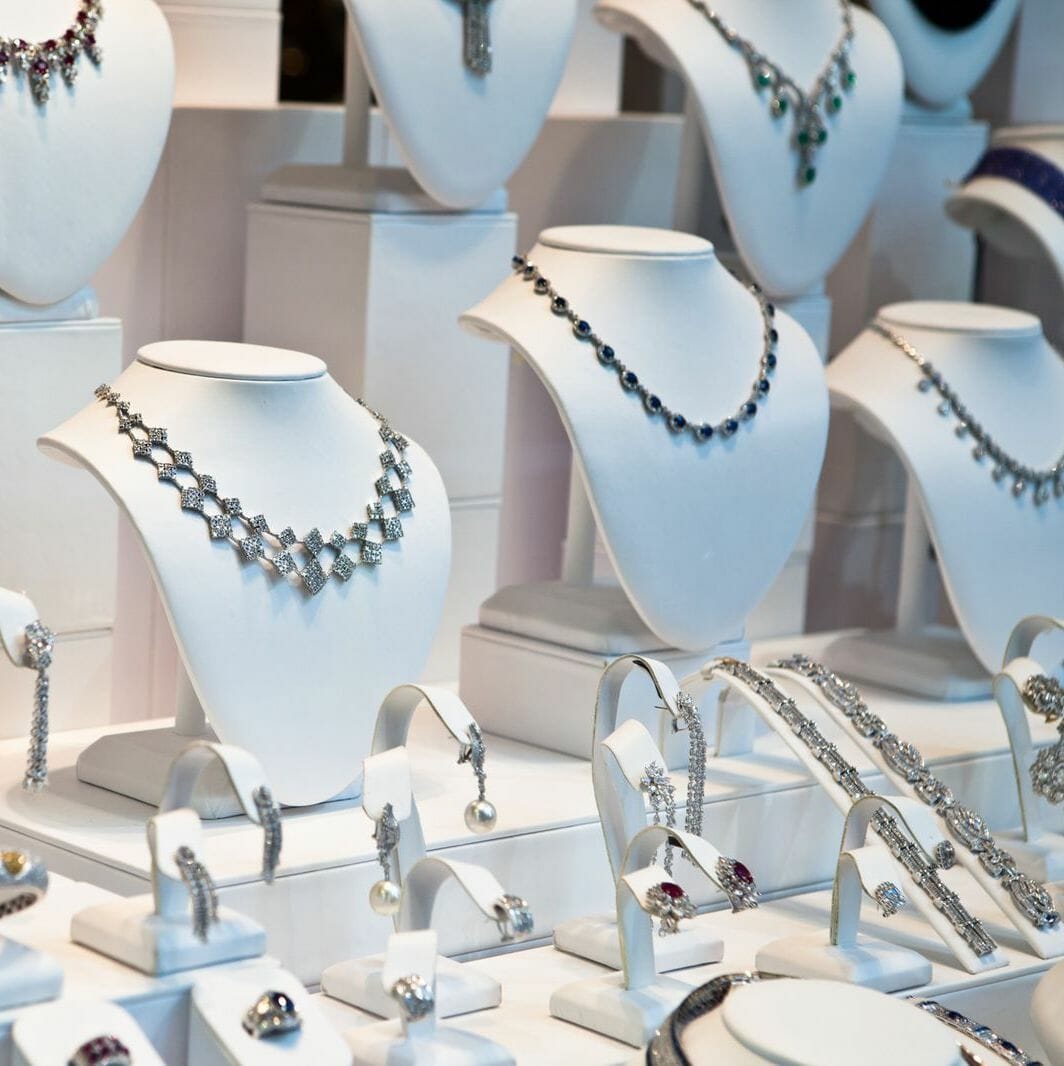
- 🪟 Showcases and display areas
- 💍 Customer presentation counters
- 📥 Receiving and unpacking areas
- 🔐 Safes, vaults, cabinets, and stockrooms
- 🔧 Repair and service departments
- 🏭 Manufacturing or processing areas
- 🔄 Internal merchandise transfers
- 🚚 Shipping and receiving
- 🏬 Transfers between business locations
- 🎪 Trade shows and temporary exhibits
A locked stockroom has a different security requirement from jewelry displayed openly to customers. The protection method should match the way merchandise is actually handled.
⚠️ Separate Theft From Inventory Discrepancies
Not every missing jewelry item has necessarily been stolen. Merchandise can also be misplaced, transferred without documentation, counted incorrectly, returned to the wrong location, or temporarily assigned to another department.
This is why theft protection should work together with strong inventory accountability.
For the broader process of controlling theft, shrinkage, misplacement, and inventory discrepancies, see Jewelry Loss Prevention.
2️⃣ Protect Jewelry at Displays and Presentation Areas
Display areas are particularly important because valuable merchandise must remain visible and accessible enough for legitimate business activity while unauthorized removal remains difficult.
A practical display-security strategy can combine:
- 🔐 Locked or controlled showcases
- 👁️ Clear employee visibility
- 📹 Camera coverage of merchandise-handling areas
- 💍 Controlled presentation procedures
- 📋 Regular display-area verification
- 🏷️ Individual identification of high-value items
- 🚨 Automated merchandise monitoring where appropriate
👁️ Maintain Control While Jewelry Is Being Handled
Merchandise can become difficult to account for when several pieces are removed from their normal locations at the same time.
- 💎 Keep high-value jewelry within a clearly controlled handling area
- 📋 Return merchandise to its assigned location after presentation or inspection
- 👥 Limit unnecessary simultaneous handling of multiple valuable items
- ⚠️ Investigate discrepancies as soon as they are discovered
For detailed retail procedures involving customers and sales personnel, see Jewelry Store Theft Prevention.
3️⃣ Use Item-Level Identification and Inventory Control
One of the most practical ways to protect jewelry from theft and unexplained loss is to know exactly which merchandise should be present and where each important item belongs.
Item-level records help distinguish an actual security event from a counting error, misplaced item, or undocumented transfer.
🏷️ Identify Individual Jewelry Items
Individual identification can use serialized product records, labels, electronic tags, or another method appropriate for the merchandise and business process.
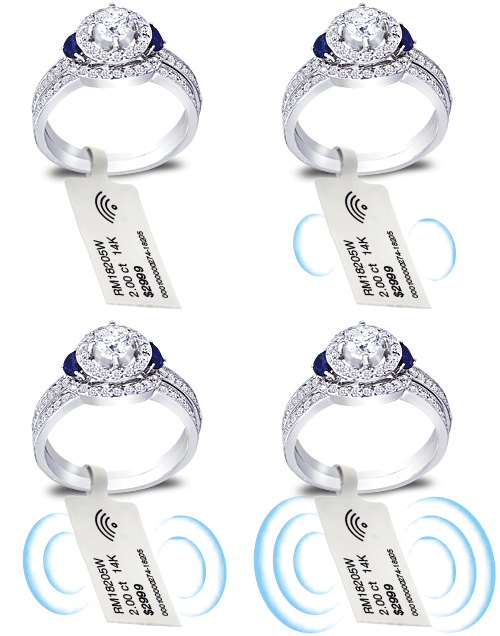
Electronic jewelry tags can support faster inventory and compatible monitoring systems when item-level electronic identification is appropriate for the project.
Learn about jewelry security tags →
📋 Verify Inventory Frequently
The longer the interval between inventory checks, the more difficult it may become to determine when and where an item disappeared.
Frequent cycle counts and targeted verification of high-value merchandise can shorten the time between a discrepancy and its discovery.
- 📥 Verify merchandise during receiving
- 🪟 Reconcile important display areas regularly
- 🔄 Document internal transfers
- 🔧 Track jewelry sent for repair or service
- 📦 Verify outgoing and returned merchandise
- ⚠️ Investigate discrepancies promptly
4️⃣ Control Access to Jewelry and Restricted Areas
Jewelry that is not actively being displayed or handled should remain within appropriately secured areas with controlled access.
Depending on the business, these areas can include safes, vaults, stockrooms, cabinets, repair departments, warehouses, offices, or other restricted locations.
🚪 Limit Access to Authorized Personnel
Personnel should have access only to the areas and merchandise necessary for their responsibilities.
Depending on the facility, access may be controlled through:
- 🔑 Controlled keys
- 🔢 PINs and keypads
- 💳 Electronic credentials
- 👆 Biometric identification where appropriate
- 🕒 Access schedules
- 📋 Access-event records
🔐 Protect Safes, Vaults, Stockrooms, and Backrooms
High-value merchandise should not depend solely on hidden or informal storage. Physical protection should be appropriate for the value of the inventory, building layout, operating procedures, and number of people requiring access.
Restricted areas can also be covered by surveillance and access records to support later review of unusual activity.
For a broader discussion of CCTV, alarms, access control, safes, and other physical security technologies, see Jewelry Store Security Systems.
5️⃣ Combine Surveillance, Alarms, and Physical Security
Traditional physical security remains an important part of protecting high-value jewelry.
Depending on the facility, a layered commercial security plan may include:
- 📹 CCTV and recorded video surveillance
- 🔔 Intrusion alarms
- 🚪 Controlled access points
- 🔐 Safes and vaults
- 🪟 Secure showcases and cabinets
- 💡 Appropriate lighting and visibility
- 🚨 Merchandise-specific monitoring systems
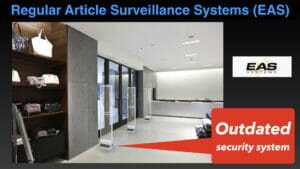
These technologies perform different functions. Cameras can provide visual evidence but do not automatically maintain item-level inventory. A locked showcase controls physical access but does not necessarily identify which piece has disappeared. Inventory records identify merchandise but do not physically prevent unauthorized entry.
Jewelry protection is generally stronger when several complementary controls are used together.
🚨 Treat Robbery and Forced Entry as Separate Risks
Shoplifting or unnoticed merchandise removal is different from robbery, burglary, smash-and-grab attacks, and other forced-entry incidents.
Businesses evaluating those risks should also see Jewelry Store Robbery and Theft Prevention.
6️⃣ Use Automated Jewelry Monitoring Where It Adds Value
Employee procedures, CCTV, physical security, and periodic inventory checks may not always provide continuous information about merchandise between manual inspections.
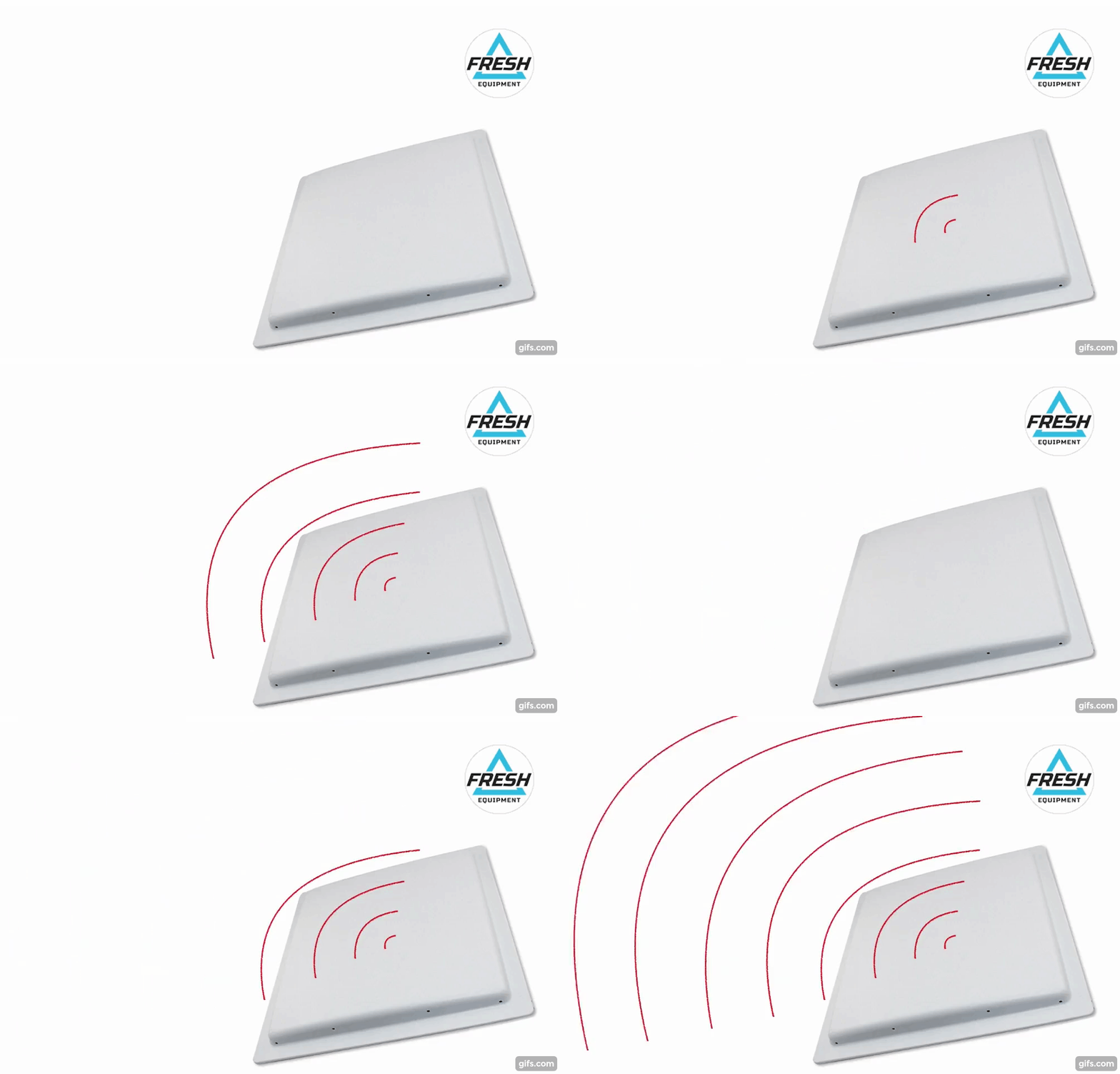
For selected high-value jewelry, automated monitoring can provide another layer of protection by checking whether individually identified merchandise remains inside a configured protected area.
🛡️ Smart Shelf Jewelry Monitoring
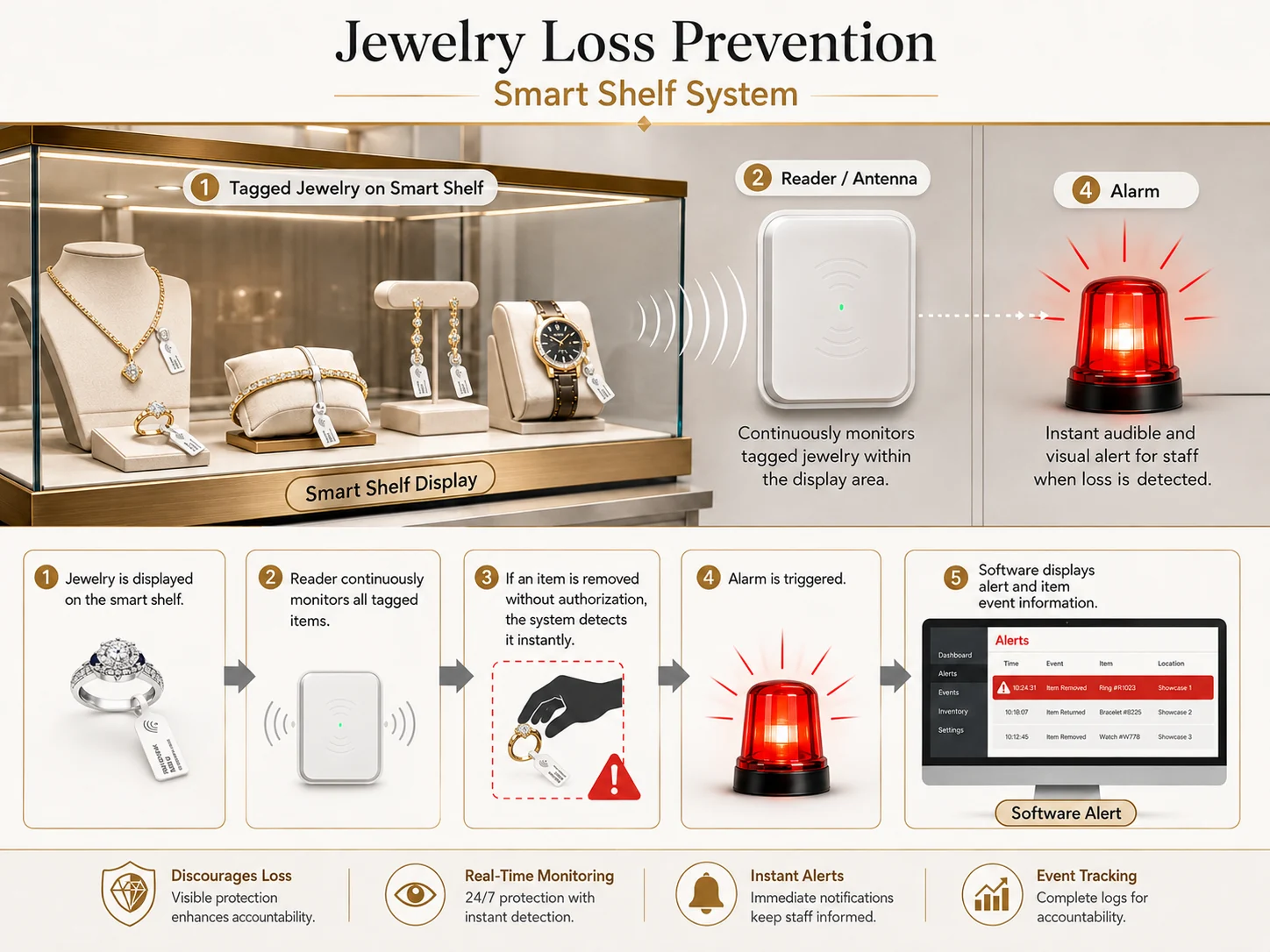
The Fresh USA Smart Shelf system can monitor individually tagged jewelry within a configured showcase, counter, cabinet, display area, or other protected zone.
If merchandise that should be present is no longer detected, the system can identify the affected item and create a security event.
This approach can be useful for small high-value merchandise because an item may disappear from a display area before a person ever approaches a conventional exit-detection point.
🌐 Core Local Monitoring Can Operate Without Public Internet
Core Smart Shelf local monitoring does not require a public Internet connection.
Local monitoring and inventory functions can continue when an external Internet connection is unavailable. Remote-access or remote-communication functions depend on the communication options selected for the project.
Learn how Smart Shelf monitoring works →
Automated monitoring should be treated as one part of a broader protection strategy rather than a replacement for employee procedures, physical security, inventory control, and incident-response policies.
7️⃣ Protect Jewelry During Transfers, Repairs, and Transportation
Jewelry becomes vulnerable whenever it moves outside its normal display or storage location.
This can occur during internal transfers, repair work, manufacturing processes, trade shows, movement between facilities, receiving, or shipment.
- 📋 Record which merchandise is being transferred
- 👤 Establish responsibility for important handoffs
- 🔧 Document jewelry sent for repair, adjustment, or service
- 🏭 Track merchandise moving through production or processing areas
- 📦 Verify merchandise before shipment
- 🧾 Verify it again when received
- 🚚 Use transportation procedures appropriate for high-value merchandise
- ⚠️ Investigate transfer discrepancies immediately
A clear chain of custody makes it more difficult for valuable merchandise to disappear without identifying where responsibility changed.
8️⃣ Establish Consistent Employee Procedures
Security technology becomes less effective when everyday merchandise-handling procedures are inconsistent.
Employees and other authorized personnel should understand:
- 💍 How jewelry should be handled and presented
- 🪟 Where merchandise belongs after handling
- 🔐 Who is authorized to enter restricted areas
- 📋 How important merchandise transfers should be recorded
- ⚠️ How quickly missing-item discrepancies should be reported
- 📹 When surveillance records should be reviewed
- 🚨 How to respond to alarms or monitoring events
Procedures should be practical enough to follow during normal operations and consistent enough that unusual activity becomes easier to recognize.
9️⃣ Investigate Missing Jewelry Immediately
When an important jewelry item cannot be located, investigation should begin promptly rather than waiting for the next complete inventory.
- 🔍 Confirm that the item is actually missing.
- 🪟 Check its assigned showcase, tray, cabinet, storage area, or work location.
- 📋 Review inventory and merchandise-transfer records.
- 👥 Determine who recently handled the merchandise.
- 📹 Review relevant surveillance footage when available.
- 💻 Review monitoring or access records where applicable.
- 📝 Document the discrepancy and investigation results.
Reducing the time between disappearance and investigation can make it easier to reconstruct recent merchandise activity.
✅ How to Protect Jewelry From Theft: Commercial Checklist
Use this checklist when reviewing jewelry security in a retail, wholesale, manufacturing, storage, service, exhibition, or other commercial environment:
- ✓ Is valuable jewelry kept in controlled display or storage areas?
- ✓ Are merchandise-handling procedures clearly defined?
- ✓ Can individual high-value items be identified?
- ✓ Are important inventory areas verified regularly?
- ✓ Are merchandise transfers documented?
- ✓ Is access to safes, stockrooms, warehouses, and restricted areas controlled?
- ✓ Does surveillance cover important merchandise-handling locations?
- ✓ Are authorized personnel trained in jewelry-security procedures?
- ✓ Are missing-item discrepancies investigated promptly?
- ✓ Would automated monitoring help discover missing merchandise sooner?
🔗 Choose the Right Jewelry Protection Resource
Jewelry protection includes several different security problems. Each specialized Fresh USA resource below focuses on a different part of the overall strategy.
| If You Need… | See This Resource |
|---|---|
| Day-to-day theft prevention procedures specifically for a jewelry store | Jewelry Store Theft Prevention |
| A broader strategy for theft, shrinkage, misplacement, inventory errors, and accountability | Jewelry Loss Prevention |
| CCTV, alarms, access control, safes, and other physical security technologies | Jewelry Store Security Systems |
| Robbery, burglary, smash-and-grab, and forced-entry risks | Jewelry Store Robbery and Theft Prevention |
| Automated jewelry monitoring, security tags, theft alerts, and fast inventory | Jewelry Theft Prevention System |
❓ How to Protect Jewelry From Theft FAQ
What is the best way to protect jewelry from theft?
Commercial jewelry protection works best as a layered strategy combining secure displays and storage, controlled access, consistent handling procedures, item-level inventory accountability, surveillance, alarms, and appropriate merchandise-monitoring technology.
How can businesses reduce jewelry theft during handling?
Businesses can maintain clear control of jewelry while it is displayed, presented, repaired, processed, transferred, or shipped; document important handoffs; return items to assigned locations; and investigate discrepancies promptly.
How does inventory control help protect jewelry?
Accurate item-level inventory records make it easier to determine which merchandise should be present, where it belongs, and when a discrepancy occurred. Frequent verification also reduces the time between an item disappearing and the problem being discovered.
Should businesses handling valuable jewelry use security cameras?
Video surveillance can provide an important layer of visual monitoring and event documentation. It works best when combined with controlled access, secure storage and displays, inventory procedures, and appropriate merchandise monitoring.
Can electronic tags help protect jewelry?
Yes. Electronic tags can give individual jewelry items a unique identity for compatible inventory and monitoring systems. The appropriate tag and system depend on the merchandise, installation, and required protection method.
Can jewelry be monitored while it is inside a showcase or display area?
Yes. A properly configured Smart Shelf system can monitor individually tagged jewelry inside a designated showcase, counter, cabinet, or other protected area and create a security event when monitored merchandise is no longer detected.
Does jewelry monitoring require Internet access?
Core local Smart Shelf monitoring can operate without a public Internet connection. Functions that require remote communication depend on the communication configuration selected for the system.
Is jewelry theft prevention the same as a complete security system?
No. Merchandise theft prevention is one part of a broader jewelry security strategy. Complete physical security may also include CCTV, intrusion alarms, access control, safes, secure doors, employee procedures, and protection against burglary or robbery.
🛡️ Protect Jewelry With Multiple Layers of Security
The answer to how to protect jewelry from theft is not a single security product. Effective commercial jewelry protection combines physical security, controlled merchandise handling, inventory accountability, surveillance, restricted access, and appropriate automated monitoring.
Fresh USA can help businesses evaluate whether item-level monitoring, jewelry security tags, Smart Shelf technology, faster inventory management, or a complete jewelry theft prevention system should be added to an existing security strategy.